Health Center Funding Policy Leadership
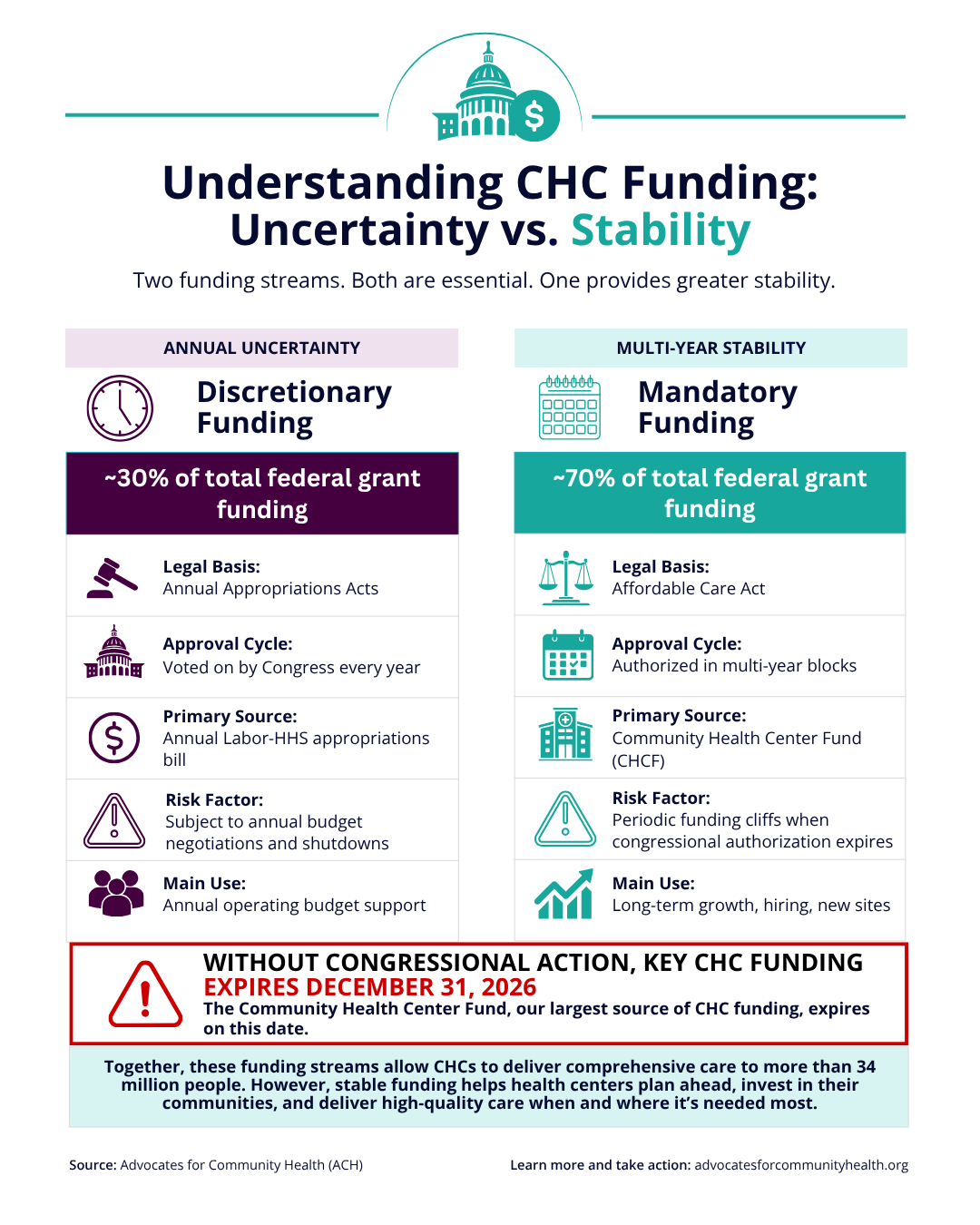
The Community Health Center Fund (CHCF) expires on December 31, 2026, creating significant uncertainty for health centers serving millions of patients in rural and underserved communities.
At the same time, rising workforce costs, Medicaid instability, infrastructure needs, inflation, and growing demand for behavioral health and primary care services are placing additional strain on already thin operating margins.
Through its CHC Invest campaign, ACH is leading federal advocacy efforts to secure long-term, sustainable investment in community health centers while advancing policy solutions that ensure financial sustainability and protect access to care nationwide.
Health Center Funding Impact
1-3%
Average operating margin for community health centers, leaving little flexibility to absorb rising costs
70%
Of federal health center grant funding comes from the Community Health Center Fund, making long-term federal investment critical to sustainability
$13 Saved
For every $1 invested in primary care, by preventing costly complications and emergency department visits
1 in 11
People rely on a community health center for care, including patients in rural and underserved communities nationwide
The Funding Cliff Facing Community Health Centers
Community health centers cannot continue doing more with less indefinitely.
Most CHCs operate on razor-thin margins, leaving little flexibility to absorb rising costs while continuing to expand access to care. Short-term funding cycles create instability, delay long-term planning, and make it harder for health centers to recruit workforce, modernize infrastructure, and sustain services in high-need communities.
Without Congressional action, health centers may face:
- Delayed hiring and workforce shortages
- Reduced behavioral health, dental, and enabling services
- Longer patient wait times
- Increased uncompensated care burdens
- Deferred infrastructure and technology upgrades
- Greater financial instability for rural and underserved providers
Congress must provide stable, long-term investment in the Health Center Program to protect access to care and strengthen the nation’s primary care infrastructure.

Why CHC Invest Matters
Community health centers provide comprehensive primary and preventive care regardless of insurance status or ability to pay. They reduce avoidable emergency department visits, improve chronic disease management, coordinate care across settings, and expand access to behavioral health, dental care, pharmacy services, and preventive care.
Health centers also serve as major economic engines in local communities — creating jobs, supporting workforce development, and strengthening regional health infrastructure. CHCs are nonprofit, community-governed organizations with patient-led boards that ensure care is responsive to local needs.
Yet significant gaps in access to care remain:
- 1 in 5 Americans lives with a chronic disease
- 1 in 3 still lacks access to primary care
- Health center funding is moving in the wrong direction: falling from $138.16 to $106.83 per patient over the past 5 years.
Investing in CHCs helps close that gap and expand access to the gold standard of community-based care.
Through increased mandatory and discretionary funding, ACH’s CHC Invest campaign supports stronger operations, workforce capacity, infrastructure, and innovation across the Health Center Program.
Why Community Health Centers Work
Community health centers are one of the most effective and bipartisan investments in health care. Their impact is visible in every type of community — rural, urban, suburban, and frontier alike, which is why health centers have maintained strong bipartisan support for more than 60 years. Research consistently shows that investing in primary care lowers long-term health care costs while improving outcomes.
Health centers:
- Reduce avoidable hospitalizations and emergency department utilization
- Improve preventive care and chronic disease outcomes
- Deliver integrated, community-based care
- Reach underserved populations more effectively than many traditional systems
- Generate significant return on federal investment
Community health centers are nonprofit, community-governed organizations with patient-majority boards that ensure care remains responsive to local needs. Federal investment in health centers is investment in long-term community health, economic stability, workforce development, and primary care access.
ACH’s CHC Invest Priorities
Understanding the difference between mandatory and discretionary funding is critical to ensuring long-term stability for health centers. ACH urges Congress to strengthen long-term investment in CHCs through both mandatory and discretionary funding.
1. Increase the Community Health Center Fund
$7.87 billion annually for at least three years
ACH urges Congress to increase the CHCF to provide the stability health centers need to meet rising patient demand and plan for long-term sustainability. This investment would strengthen operations, expand access to care, support workforce growth, and help health centers respond to rising patient demand
2. Strengthen Annual Appropriations
$2.88 billion in discretionary funding for FY 2027
ACH urges Congress to strengthen discretionary funding for the Health Center Program to support ongoing operations and patient care delivery. Together, mandatory and discretionary funding create the financial foundation health centers need to sustain and expand care delivery nationwide.
3. Invest in Long-Term Health Center Growth
An increased Community Health Center Fund, combined with strong annual appropriations and investments in workforce programs, and infrastructure resilience, would allow health centers to grow in four critical areas:
- Operations
- Infrastructure
- Workforce
- Innovation
These investments help health centers modernize care delivery, expand access, strengthen staffing, and improve patient outcomes.
CHC Invest Advocacy & Impact
1. Federal Advocacy Leadership
- Leading Congressional advocacy around Community Health Center Fund reauthorization
- Engaging directly with CMS, HRSA, Congressional offices, and federal agencies
- Advancing policy solutions related to Medicaid, workforce, payment reform, and infrastructure resilience
- Organizing coalition efforts with national and state partners
- Elevating the bipartisan value of community health centers on Capitol Hill
3. National Visibility
- Amplifying health center voices through national media engagement
- Elevating member stories and policy priorities through ACH’s Community Health Centers Unfiltered podcast and Substack
- Positioning community health centers as essential primary care infrastructure
3. Member Engagement
- Equipping members with advocacy resources, communications support, and rapid-response materials
- Supporting health center leaders in engaging policymakers and sharing local impact stories
- Connecting members to national advocacy opportunities and coalition efforts
About ACH
Join us in advocating for financial sustainability for community health centers and the patients they serve.Learn More