Over the past year, the federal policy landscape has shifted in ways that may have significant implications for the nation’s healthcare workforce. Under the current administration, several proposed changes to immigration programs and federal student loan policies aim to tighten oversight, better align benefits with labor market needs, and simplify complex systems. Together, these proposals reflect the Trump Administration’s broader priorities around workforce regulation and fiscal responsibility.
These changes come at a critical moment for community health centers (CHCs), which are already grappling with significant workforce shortages and high levels of burnout among frontline clinicians and staff. Below is an overview of how the changes could affect the nation’s community health center workforce—and what CHCs need to know so they can navigate these changes and recruit, train, and retain the staff that keeps our communities healthy.
Three Ways that Proposed Policies Could Impact the CHC Workforce
Several recent immigration-related policy proposals from the Trump Administration are expected to have serious consequences for the nation’s health care workforce. These new policies aim to more closely tie work visas to wages and job requirements and increase oversight to reduce the potential for fraud, waste, and abuse. For example, in recent months, the Trump administration has implemented a $100,000 entry fee for new H-1B visas, and Employment Authorization Documents (EAD) for visa holders will no longer renew automatically and will be valid for shorter periods of time.
H-1B workers have played an increasing role in the health care industry in recent years with new and continuing H-1B visa approvals for the health care and social assistance industries rising by 8% between FY 2022 and 2025, and these new requirements could have an impact on the number of visa-holders available for health care positions.
At the same time, changes to federal student loan policies included in H.R. 1 would limit how much graduate and professional students can borrow, eliminate some loan programs, and change repayment options. This change means potentially fewer workers who can afford to take on healthcare training at the very time there are tightening restrictions on the number of foreign healthcare workers permitted to work in the U.S. Many of these policies are already in effect or are scheduled to take effect beginning in 2026, creating uncertainty for both employers and workers.
What does all this mean for health centers? Three key implications stand out:
1. Tighter H-1B selection and higher costs could equal fewer clinicians available to safety-net employers like CHCs.
Stricter H-1B selection criteria and higher associated costs shift visa access toward higher-paying employers and add financial risk to hiring decisions. Because CHCs, rural hospitals, and other safety-net providers offer more modest salaries than large health systems, these changes disproportionately limit their ability to recruit international medical graduates and foreign-trained clinicians.
These clinicians frequently serve in primary care and behavioral health roles, often in rural and medically underserved areas. Reduced access to this talent pool could further strain communities already facing provider shortages.
2. Increased work authorization “churn” could equal onboarding delays and staffing disruptions.
Many CHC staff working under a visa rely on Employment Authorization Documents (EADs). The new policy changes require shorter validity periods for these visas without automatic extensions once the validity period ends. This means an increased risk that staff will lose their work authorization and face compliance burdens. In turn, this leads to onboarding delays, disrupted patient care, and added strain on already stretched teams. Over time, uncertainty increases and lengthens, potentially deterring international clinicians from pursuing jobs in safety-net settings or the U.S. in general.
3. Higher financial barriers to training could equal fewer clinicians willing/able to choose CHC careers.
The “One Big Beautiful Bill Act’s” graduate and professional loan changes, including the elimination of Grad PLUS for new borrowers and tighter borrowing caps, increase out-of-pocket costs and push more students toward private loans, making it harder for them to enter clinical programs. Reduced access to income-driven repayment and loan forgiveness further weakens incentives to pursue lower-paying public-service roles, such as those in community health centers and rural areas.
By narrowing access to international clinicians, increasing uncertainty around work authorization, and raising the cost of healthcare training, these policies collectively make it harder for community health centers to build and sustain the workforce needed to meet community demand.
Looking Ahead
As immigration and student loan policies continue to evolve, ACH remains focused on what matters most: ensuring community health centers have the skilled, diverse, and supported workforce needed to deliver high-quality care. These pressures also risk increasing burnout among existing staff who are asked to do more with fewer resources.
ACH also recognizes that workforce sustainability depends not only on recruitment, but on retention. Ongoing financial strain, mounting administrative demands, and staffing limitations are making it harder for clinics to sustain their workforce and for clinicians to develop long-term careers in safety-net settings.
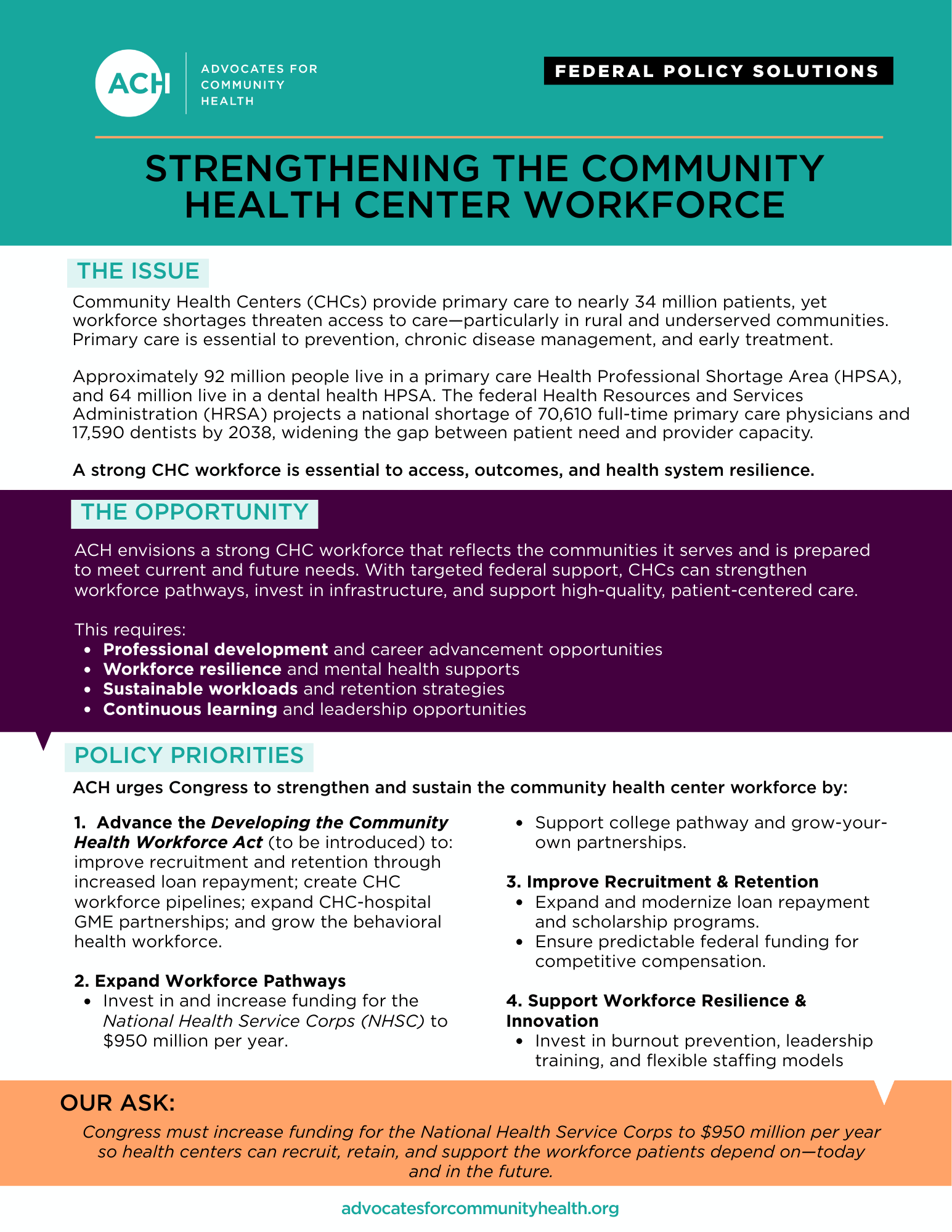
ACH is working to ensure that health centers can weather these changes, endorsing Congressional efforts to exempt the health care sector from the new $100,000 H-1B visa fee and supporting significantly increased funding for the National Health Service Corps and the Teaching Health Centers Graduate Medical Education program. ACH is also exploring ways to address these issues through our newly launched coalition, the Alliance to Strengthen America’s Health Workforce for the Underserved, which was launched by organizations including ACH, the Association of Clinicians for the Underserved, the National Medical Association, and the National Association of Rural Health Clinics, who comprise the Alliance’s Executive Committee.
As these policy discussions and proposals continue, ACH intends to continue advocating for solutions that preserve and strengthen the healthcare workforce pipeline, ensuring community health centers remain a place where clinicians can train, grow, and build lasting careers to serve their communities.