The federal healthcare landscape is shifting rapidly, but community health centers (CHCs) continue to demonstrate how community-driven primary care can meet the moment.
That was the clear message from Advocates for Community Health’s 5th Annual Member Meeting, where health center leaders, federal officials, and policymakers gathered in Washington to chart the next chapter in health care access.
Across conversations on Capitol Hill, federal policy panels, and member discussions, six themes emerged about the future of community health centers:
1. The fight to protect 340B for health centers must continue
As HRSA works to relaunch the 340B rebate model, protecting health centers within the program remains a top priority for ACH and its members.
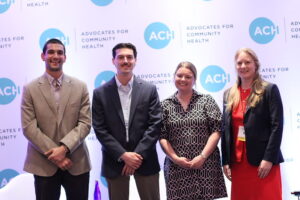
A panel of key congressional staff — including Colin Gwillim, Legislative Assistant in the Office of U.S. Rep. Jack Bergman (R-MI), Lucie Flowers, Legislative Assistant in the Office of U.S. Rep. Neal Dunn (R-FL), and Dillon Cooke, Legislative Director in the Office of U.S. Rep. Scott Peters (D-CA) — emphasized that while lawmakers understand the importance of CHCs, they are looking for data that demonstrate how 340B savings are used locally, and health centers have that because that is exactly what the program was designed to support.
Beyond data, health centers must continue sharing patient stories that illustrate the real-world impact of the program, particularly as more patients turn to safety-net providers amid potential Medicaid eligibility shifts after 2027.
“Advocates for Community Health,” noted Cooke, “will be one of the groups we reach out to.”
ACH will continue pursuing every available avenue to ensure health centers remain protected, and has begun exploring ways to showcase this data.
2. Health centers must stay nimble in a rapidly changing policy environment
Health center leaders must remain agile as federal and state policy shifts accelerate.
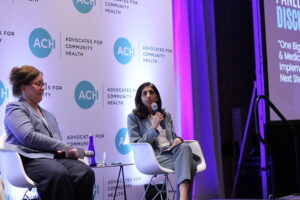
With Medicaid changes unfolding and potential adjustments to federal grant funding structures, the environment is evolving quickly. As Hemi Tewarson, Executive Director of the National Academy for State Health Policy (NASHP), noted during a panel discussion on H.R. 1 implementation, with 29 gubernatorial races this fall, the country is entering “a time of change at a time of incredible stress with Medicaid changes and H.R. 1.”
Dr. Shannon Dowler, former Chief Medical Officer for North Carolina Medicaid, pointed out that 26 Medicaid directors have turned over in recent months, underscoring how tenuous the Medicaid landscape is right now. For community health centers, Medicaid stability is not an abstract policy debate; rather, it directly determines whether millions of patients can continue accessing primary care in their communities.
Despite these challenges, health centers continue to meet community needs. “Health centers have grown to a really large scale and need to be supported as such,” said keynote speaker on day two, Abe Sutton, Director of the Center for Medicare and Medicaid Innovation (CMMI).
As states work to distribute funds from the Rural Health Transformation Program (RHTF), CHC participation will depend largely on state discretion.
Kate Sapra, Acting Deputy Director of the Office of Rural Health Transformation at CMS, told the audience that the moment demands both strategic adaptation and continued advocacy to ensure CHCs have the resources needed to meet rising demand. She also highlighted opportunities for health centers to engage with their states, build essential partnerships, and secure their place in rural transformation efforts.
“The goal of the program is to make rural America healthy,” said Sapra. “That’s going to be hard to do if health centers aren’t part of the conversation.”
While upcoming legislative and administrative changes present challenges, they also present opportunities, added panelist Gabrielle Kalisz Minarik, Program Manager for the Paragon Health Institute. Policymakers increasingly look to health centers as models of success despite difficult operating environments.
3. Community Health Centers are the foundation of prevention and the MAHA agenda
Community health centers are uniquely positioned to lead the next era of chronic disease prevention. In many ways, the prevention-focused goals of the MAHA agenda mirror the model community health centers have been implementing for six decades.
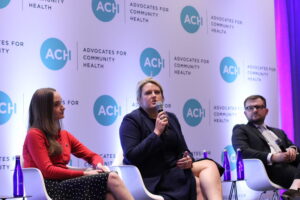
Hannah Anderson, Director of Healthy America Policy and Senior Director of Policy at the America First Policy Institute, told attendees during the One Year of Make America Healthy Again panel that health centers are already teaching patients how to live healthier lives.
“There would never have been an opportunity for HHS Secretary Kennedy to advance the MAHA agenda if it wasn’t for community health centers,” Anderson said. “You are the building block of MAHA — you’re already doing it.”
As policymakers across Washington discuss the goals of the Make America Healthy Again (MAHA) movement, CHCs are already delivering the integrated primary care, behavioral health services, nutrition support, and chronic disease management needed to improve long-term population health.
Health centers are not simply providers within this framework — they are the foundation that makes prevention-focused care possible in communities across the country.
4. Workforce and rural health challenges persist — but CHCs remain the solution
Workforce shortages continue to challenge rural and underserved communities, but community health centers are also serving as training grounds for the next generation of primary care providers.
Federal officials emphasized that strengthening the workforce pipeline remains critical to sustaining rural care systems. Israil Ali, Acting Deputy Associate Administrator at HRSA’s Bureau of Health Workforce, and Michael Fallahkhair, Deputy Associate Administrator at HRSA’s Federal Office of Rural Health Policy, addressed the realities facing rural care delivery.
Recruitment may bring providers through the door, but retention keeps clinics open.
Ali highlighted federal investments such as the National Health Service Corps, which encourages clinicians to remain in underserved communities after completing their training.
At the same time, technology, particularly artificial intelligence, is becoming an increasingly important tool in expanding access to care. AI-driven clinical decision support can help health centers and rural clinics extend the reach of limited provider capacity while improving care delivery.
“Technology more generally presents a huge opportunity to meaningfully improve health and affordability, especially when it comes to rural and federally qualified health centers,” said Jacob Shiff, Chief AI & Technology Officer at the Center for Medicare & Medicaid Innovation (CMMI), during the panel on AI, Digital Tools, and the Future of Health Care.
Fallahkhair also discussed funding opportunities aimed at strengthening rural care systems, including support for workforce development, behavioral health services, and pilot funding to help health centers prepare for participation in value-based care models.
Taken together, targeted workforce investments and technology tools will help ensure community health centers remain the backbone of care in rural and underserved communities.
5. Value-Based Care models centered on CHCs can change how care is delivered and financed

Value-based care remains a central focus of federal health policy, and community health centers will play an increasingly important role in shaping how these models operate.
CMMI Director Abe Sutton said the Innovation Center’s mission is to improve quality while lowering costs, which ultimately comes down to affordability. But for health centers, the success of value-based care will depend on whether new models account for the financial realities facing providers who care for the nation’s most vulnerable patients.
He praised CHCs as an essential source of care but acknowledged that downside financial risk remains a major barrier preventing many safety-net providers from participating in innovative value-based care models such as ACO REACH.
New models, including the Long-term Enhanced ACO Design (LEAD), include elements specifically designed to make participation feasible for safety-net providers and to better align payment with the comprehensive care that CHCs already deliver.
6. Advocacy still moves policy and health center voices make an impact

Perhaps the most powerful takeaway from this year’s meeting was the continued impact of health center advocacy.
Hannah Anderson noted that this is a “problem-solving administration” that wants to hear directly from health centers about what is working and where challenges remain. Max Seltzer, Health Policy Director for U.S. Senator Roger Marshall, MD (R-KS), underscored the role CHCs play on the ground, telling attendees, “You guys are the do-ers.”
From cementing health centers as leaders in chronic disease prevention, aligning with the goals of Make America Healthy Again efforts in Congress and the Administration, to advocating for structural integration within the Rural Health Transformation Program, the collective voice of health centers was impossible to ignore.
During Lobby Day, ACH members held nearly 100 meetings with Members of Congress, advocating for stable health center funding, protection of the 340B program, and limiting Medicaid policy changes that may negatively impact CHCs and the patients they serve.
As federal healthcare policy continues to evolve, the message from this year’s meeting was clear: community health centers are not just part of the conversation — they are central to the future of America’s primary care system.
Thank You to Our Partners
A special thank you to our corporate partners who helped make this year’s meeting possible: UnitedHealthcare, our Visionary Sponsor; Aledade and Equiscript, our reception sponsors; and CareMessage, CHCollective, Collective Energy, and ConferMED, our additional sponsors.
Your support helps advance the next chapter of health center advocacy.